
Cleaning Guides
How Often Should You Clean Your Carpet? 
Ash on carpet is one of those problems that looks manageable until you actually try to deal with it. Whether it’s drifted out of the fireplace on a Sunday evening or landed from a cigarette that got too close to the rug, the stuff has a talent for making itself at home in carpet fibres. And the moment you try to wipe it up, it spreads.
The instinct is to grab whatever cleaner is under the sink and get scrubbing. That approach usually makes things worse. The good news is that getting ash out of carpet doesn’t require anything complicated. The order you do things matters far more than what you use.
Let the ash dry and settle completely, then vacuum it up gently using a nozzle attachment held just above the surface. Apply baking soda, leave it for at least 20 minutes, then vacuum again. Follow with a diluted white vinegar solution dabbed on with a clean cloth, working from the outside of the stain inward. Blot, never rub. Finish by rinsing with cold water and allowing the carpet to air dry fully.
That’s the core of it. The order matters more than most people realise. Here’s how to do it properly from start to finish.
If the ash is still warm or recently fallen, leave it alone for a few minutes. Fresh ash is light and powdery, which sounds like it should be easy to clean. It is, but only if you don’t disturb it too soon. The second you start poking at it, it lifts into the air and settles back down across a wider area of carpet. Patience here saves you a much bigger clean-up job later.
Use a handheld vacuum or the nozzle attachment on your regular hoover. Hold it just above the surface rather than pressing it down into the pile. You want to lift the ash, not push it deeper into the fibres. Go slowly. Make several light passes rather than one heavy one.
If you only have a full-size hoover, use the lowest suction setting and a nozzle attachment rather than the floor head.
Once you’ve vacuumed up what you can, sprinkle a generous layer of baking soda over the affected area. Let it sit for at least 20 minutes. Baking soda is mildly alkaline, which helps it draw out ash particles still clinging to the fibres. It also deals with any smoky smell left behind. Vacuum it up thoroughly afterwards before moving on.
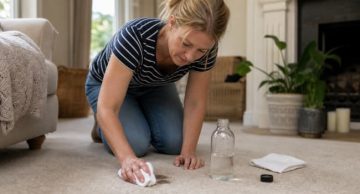
Mix one part white vinegar with two parts cold water. Dampen a clean white cloth with the solution and blot the stained area gently. Work from the outer edge of the stain inward so you’re not spreading it. Don’t saturate the carpet. A damp blot is all you need. Repeat with a fresh section of cloth until the stain lifts.
Once done, blot the area with plain cold water to rinse, then press a dry cloth down firmly to absorb the moisture. Leave the carpet to air dry fully before walking on it.
For wool or silk carpets, skip the vinegar entirely and use cool water only. Acidic solutions can damage delicate natural fibres.
If ash has been sitting for a while before you treat it, the same method still works. You may just need to repeat the baking soda and vinegar steps more than once. A set stain won’t lift in one pass, but it will shift gradually with patience. The key is not to rush and not to add more moisture than the carpet needs.
For a stain that has a strong smoky odour, leave the baking soda on for longer. An hour or more will draw out significantly more residue than a 20-minute application. Some heavily soiled areas may benefit from a second baking soda treatment before you reach for the vinegar.
If you’ve treated the area two or three times without real improvement, or the stain covers a large section of carpet, it’s worth calling in a professional carpet cleaning service. Specialist equipment reaches deep into the pile and extracts embedded residue without over-wetting the carpet or damaging the fibres. A cloth and a spray bottle have their limits.
It’s surprisingly easy to make an ash stain worse. Most of the common mistakes come from acting quickly without thinking through what ash actually does when it meets moisture or friction. Here’s what to keep in mind.

Yes, it does. The same stain behaves differently depending on what the carpet is made from, how dense the pile is, and how it was dyed. Getting ash out of carpet on a flat-weave synthetic is a different job from dealing with a thick wool rug.
Synthetic carpets, such as nylon or polyester, are generally more forgiving. They resist moisture better, dry faster, and tolerate a vinegar solution without issue. The fibres don’t absorb staining agents as readily as natural materials, so ash tends to sit closer to the surface rather than working its way deep into the pile.
Natural fibre carpets are more sensitive. Wool, in particular, can felt or distort if you use too much liquid or scrub too aggressively. Silk is even more delicate and should be treated with cool water only. For any carpet labelled dry-clean only, skip the DIY approach entirely and call a professional before you risk permanent damage.
Deep-pile or shag carpets present a different challenge: ash can fall further down between the fibres and be harder to vacuum out in one pass. Take extra time with the vacuum step and consider running a second baking soda treatment before applying any liquid. The extra effort at the dry stage prevents the residue from turning into a muddy smear once moisture is introduced.
If your carpet has a care label marked ‘dry clean only’ or ‘professional clean only’, do not apply any liquid at home. You risk voiding any warranty and causing permanent damage.
Get a price for professional carpet cleaning and book at a time that suits you.

Ash stains are annoying, but they’re not a disaster. With the right approach, most of them come out using nothing more than a vacuum, some baking soda, and a splash of diluted vinegar. The key is doing things in the right order and resisting the urge to scrub. Slow and steady genuinely wins here.
If the stain has set deep or covers a large area, don’t keep treating it until the carpet looks worse. Know when to stop and let a professional take over. A carpet that’s been over-treated is harder to fix than one that’s been left alone.




The only home improvement newsletter you will ever need!
We will never spam you. Pinky promise!
For more information, check out our privacy policy.